

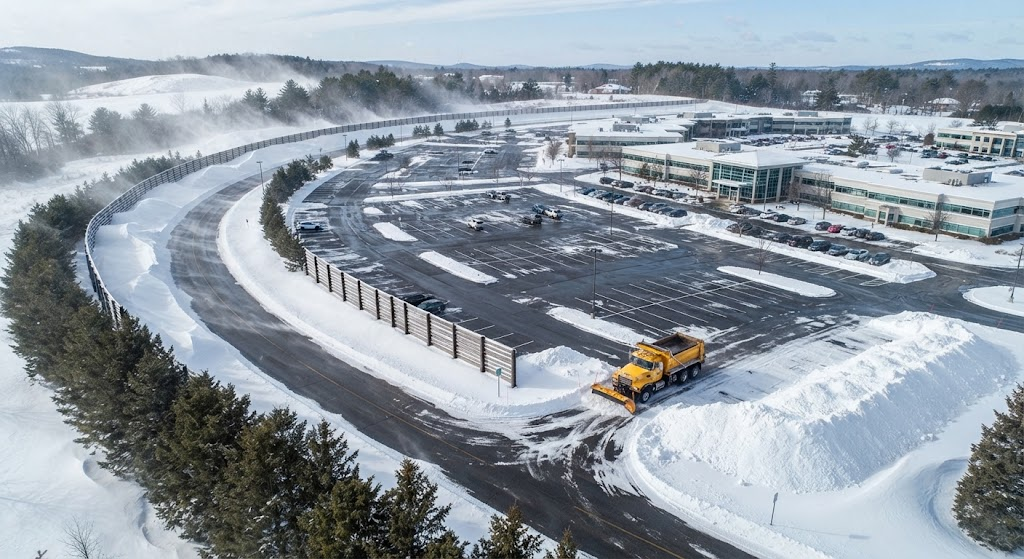
Wind Can Undo a Clean Pass in Minutes
An open commercial parking lot can look finished at midnight and partly buried again before the next shift arrives. No meaningful new snowfall is required. Loose snow from adjacent fields, landscaped areas, roof edges, or earlier piles can simply move back across exposed pavement.
Snow Removal Expert’s service approach is relevant because these sites need more than a standard accumulation trigger. Fast clearing, modern equipment, 24/7 availability, safety-focused ice control, scheduled plans, and clear pricing work best when the service plan recognizes drifting as its own operational problem.
Before winter, property managers should identify where snow normally enters the site, where it settles, and which lanes repeatedly close first.
Look Beyond Total Snowfall
A 5-centimetre event accompanied by persistent wind can create a deeper drift across one entrance than a heavier snowfall produces across a protected lot. That difference should influence the route, equipment choice, and expected number of return visits.
Map Drifts Before Setting the Route
Planning snow and ice support in Airdrie should start with the site’s exposure. Open prairie conditions can redistribute snow across roads, parking areas, sidewalks, and industrial yards after the original precipitation has ended.
Record the Upwind and Downwind Sides
Walk the property with prevailing winter winds in mind.
Mark open edges, fence lines, berms, rows of parked vehicles, buildings, loading areas, and narrow passages between structures. These features interrupt airflow and can create predictable accumulation zones.
A drift map does not need to be sophisticated. Start with the locations that repeatedly collect snow and note which direction the wind was coming from when the problem occurred.
After several events, patterns usually become obvious.
Consider Snow Fencing as a Control, Not a Cure
Snow fences work by slowing wind and encouraging blowing snow to settle before it reaches the surface being protected.
Placement matters more than simply installing a barrier. A fence positioned too close to an access road or parking edge can create a drift in exactly the wrong place.
The Alberta highway-maintenance approach reflects this principle: snow fencing is used where drifting is prevalent, with placement determined by local conditions and experience.
Commercial properties can use the same concept, provided fencing, landscaping, property boundaries, visibility, and local requirements are assessed for the specific site.
Put Snow Where the Wind Will Not Send It Back
The easiest snow pile is not always the best snow pile.
Plowing toward the upwind side of an exposed lot can create a reservoir of loose snow that the next wind event pushes straight back across cleared pavement.
Snow storage should therefore be planned before the first storm.
A professional snow and ice management program should identify primary and backup storage zones, rather than leaving pile placement entirely to the operator during the event. Storage should preserve parking circulation, loading movements, fire access, pedestrian routes, and room for later storms.
Also consider pile height.
A pile that is harmless in December can become a visibility problem after four more events. Tall windrows near exits can block a driver’s view of approaching vehicles or pedestrians.
Meltwater matters too. A strategically placed pile for wind control can become a poor choice if daytime warming sends runoff across a walkway or entrance where it freezes overnight.
Wind, visibility, storage capacity, and drainage belong on the same plan.
Design Entrances, Visibility, and Storage Zones
The highest-risk part of an exposed lot is often not its largest open surface. It is the point where moving snow interferes with movement.
Protect the Entrances First
Vehicle entrances, fire lanes, loading access, and employee approaches should have enough cleared width to tolerate some drifting without immediately losing function.
Avoid creating piles close to driveway mouths or intersections. They can narrow turning space and reduce sightlines at exactly the point where drivers need the clearest view.
The City of Airdrie removes snow windrows where they create sightline safety concerns, which is a useful reminder for private sites as well: snow placement can become a visibility issue even when the pavement itself is clear.
Leave Space for the Next Storm
Every storage zone needs reserve capacity.
If the first few events fill the only acceptable pile locations, later clearing becomes slower and more expensive. Managers may suddenly need loader work or off-site hauling that was never included in the original plan.
Before winter, estimate which areas can accept repeated stacking and which should remain permanently clear.
That simple exercise also helps contractors quote the site more accurately.
One Pass Is Rarely Enough on an Exposed Site
Wind-exposed properties should not define completion as “one plow visit.”
A better model recognizes that drifting can reactivate the property after the first clearing.
For commercial winter service around Airdrie properties, this is particularly relevant because the City itself begins plowing when snow reaches five centimetres and/or when drifting occurs. Drifting is therefore treated as an independent service condition rather than merely a side effect of snowfall.
Private sites can build the same thinking into their trigger plan.
If a primary entrance starts narrowing, a truck lane develops cross-drifts, or a pedestrian route repeatedly fills, the site may require another pass even though the snowfall total has not changed.
Repeated service should focus on the areas that actually refill.
There is little value in replowing an entire dry parking field just because one exposed access road has drifted shut.
This is where a mapped site and good dispatch communication save time: crews know exactly which zones need another look.
Set Service Triggers and Review the Plan
A wind-exposed property needs more than a centimetre-based activation rule.
Set separate triggers for accumulation, drifting, reduced visibility, narrowing entrances, loss of truck circulation, and refreeze around relocated snow.
Then decide what each trigger means.
One condition may require inspection. Another may activate a targeted plow pass. A more severe event might require continuous monitoring or relocation of accumulated piles.
After significant wind events, review what actually happened.
Did snow come from the expected direction? Did one building corner create a new drift? Did parked vehicles trap accumulation? Was a storage pile responsible for snow blowing back across the lot? Did an entrance need more frequent service than predicted?
Update the map instead of starting from scratch next winter.
An effective wind-exposed snow plan is not built around moving the greatest amount of snow as quickly as possible.
It is built around controlling where snow ends up.
Map the drift. Protect the entrances. Keep sightlines open. Put piles where the wind is less likely to reclaim them. Leave enough storage capacity for later events. And plan for the fact that a clean pass may only be temporary.
On an exposed property, the storm may stop before the snow stops moving.